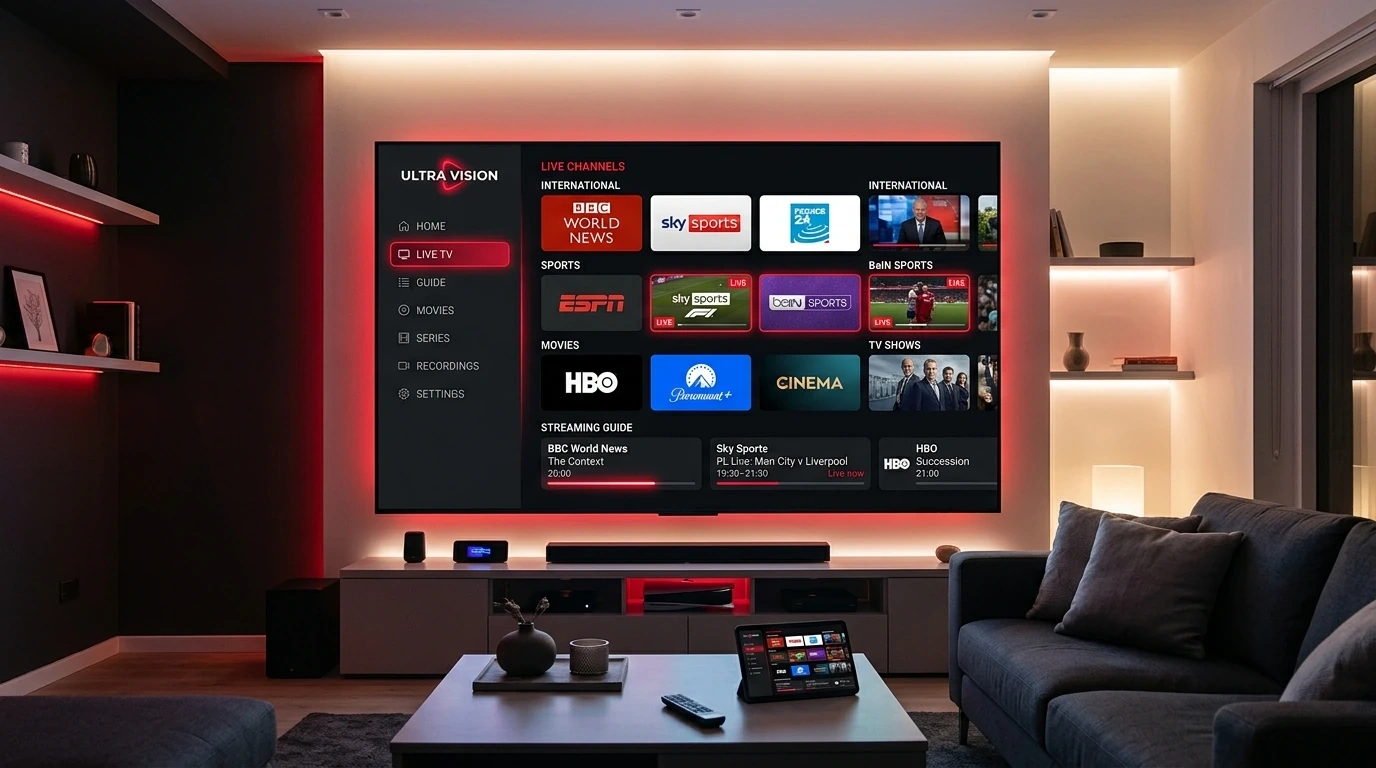
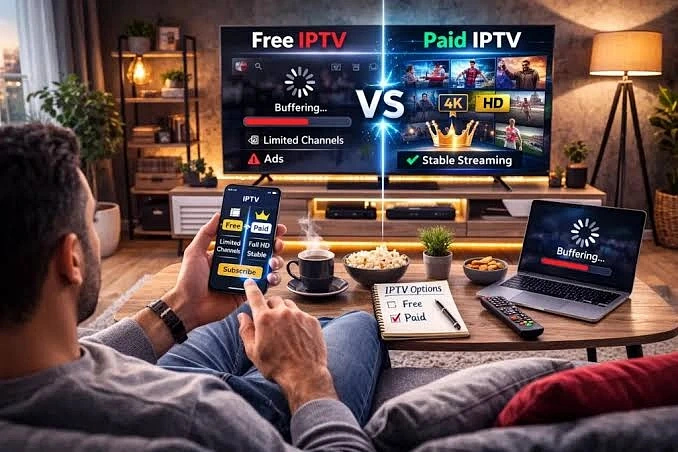
IPTV vs Cable TV in the USA (2026 Comparison): Cost, Channels, 4K Quality & Which Is Better?
The American television landscape is undergoing the most dramatic structural shift in its history. For decades, traditional cable and satellite television providers—including Comcast Xfinity, Charter Spectrum, Cox Communications, and DirecTV—enjoyed an effective geographic monopoly over live sports, national news, and prime-time entertainment. American households passively accepted annual rate hikes, labyrinthine 2-year service contracts, and climbing equipment rental surcharges simply because viable alternatives did not exist.
In 2026, that monopoly has collapsed. The cord-cutting revolution has evolved from a niche tech trend into a nationwide exodus. Tens of millions of American viewers are abandoning traditional coaxial cable networks in favor of high-performance Internet Protocol Television (IPTV).
By leveraging high-speed broadband connections and next-generation video compression codecs, premier modern services like Strong 8k tv deliver an entertainment universe that leaves legacy cable in the past: over 50,000 live international channels, premier sports packages in fluid 60 FPS, and massive on-demand libraries spanning 120,000+ movies and complete series at a fraction of traditional cable pricing.
Yet, many American consumers remain hesitant. Is IPTV genuinely reliable enough to replace traditional cable? Does it carry your essential local regional sports networks? How does the picture quality compare? And what is the real total cost once all fees are accounted for?
This comprehensive 2026 guide provides an exhaustive, head-to-head comparison between IPTV and traditional Cable TV in the United States. We break down monthly costs, dissect hidden cable fees, compare 4K and 8K picture quality, evaluate sports coverage, examine device flexibility, and help you determine the superior choice for your living room.
IPTV vs Cable TV Comparison for Viewers in the USA
The Technological Divide: How Cable Works vs. How IPTV Works
To understand the immense cost and flexibility differences between these two platforms, it is essential to understand the underlying physical architecture that powers them.
┌────────────────────────────────────────────────────────────────────────┐
│             TRADITIONAL CABLE TV vs. MODERN IPTV DELIVERY              │
├───────────────────┬────────────────────────────────────────────────────┤
│ Platform          │ Physical Delivery Architecture                     │
├───────────────────┼────────────────────────────────────────────────────┤
│ Cable TV          │ Physical coaxial / hybrid-fiber lines; QAM radio   │
│ (Xfinity/Spectrum)│ frequencies; proprietary tethered set-top boxes.   │
├───────────────────┼────────────────────────────────────────────────────┤
│ Modern IPTV       │ High-speed TCP/UDP unicast packet streaming over   │
│ (Strong 8k tv)    │ global fiber CDN networks; open multi-device apps. │
└───────────────────┴────────────────────────────────────────────────────┘
Traditional Cable TV Architecture
Traditional cable television relies on a rigid, closed-loop physical infrastructure. High-capacity optical fiber lines deliver bulk broadcast signals to neighborhood optical nodes, where the signal is converted into high-frequency radio frequency (RF) signals transmitted over copper coaxial cables directly into your house.
Using Quadrature Amplitude Modulation (QAM), the cable operator divides physical radio frequencies into dedicated bandwidth channels. To decode these encrypted RF signals, every television in your house must be connected to a heavy, proprietary hardware set-top box leased directly from the cable company. Because channel bandwidth is locked at the physical transmission layer, adding new 4K channels requires cable operators to decommission older analog channels or compress existing digital feeds heavily.
Modern IPTV Architecture
Internet Protocol Television operates on the open, flexible architecture of the internet. Instead of broadcasting every channel simultaneously over physical copper wires, IPTV utilizes unicast packet streaming. When you select a channel on your remote control, your streaming media player sends an encrypted request to high-speed content delivery network (CDN) server clusters. The server delivers only the specific video stream you are watching using modern H.265 (HEVC) or AV1 video compression protocols.
Because IPTV is software-driven and internet-native, it requires zero specialized wall wiring, zero proprietary set-top boxes, and zero technician visits. It streams seamlessly across any modern screen connected to your home Wi-Fi or broadband connection.
Category 1: Monthly Subscription Cost & The 3-Year Total Cost of Ownership
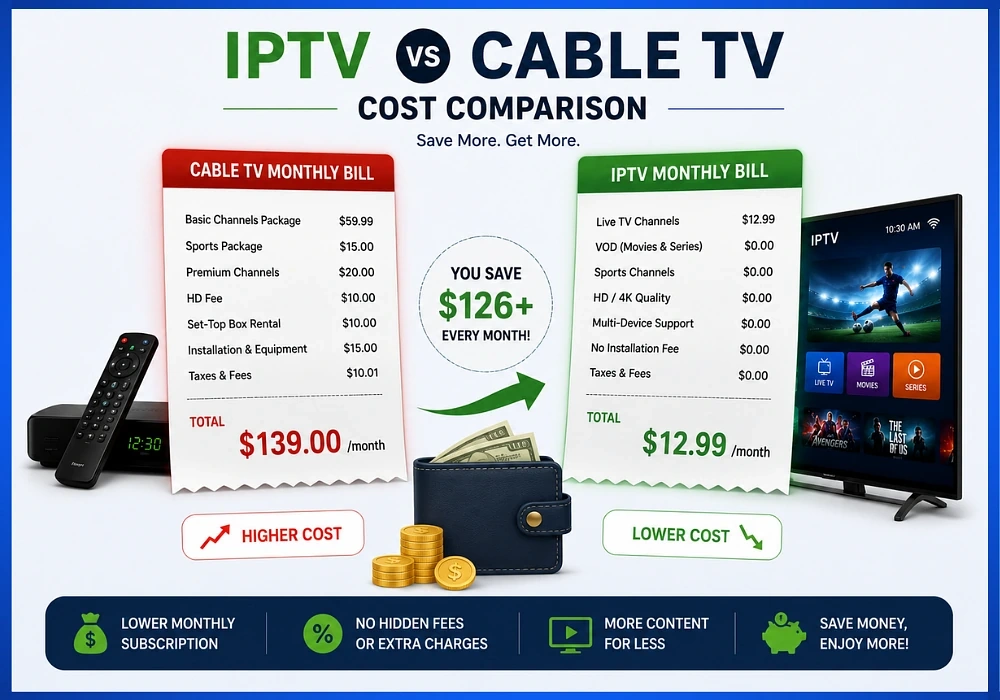
The financial disparity between traditional American cable TV and modern IPTV is nothing short of staggering. Cable television is infamous for marketing artificially low "promotional bundle rates" that balloon into astronomical monthly bills once promotional periods expire and mandatory surcharges are added.
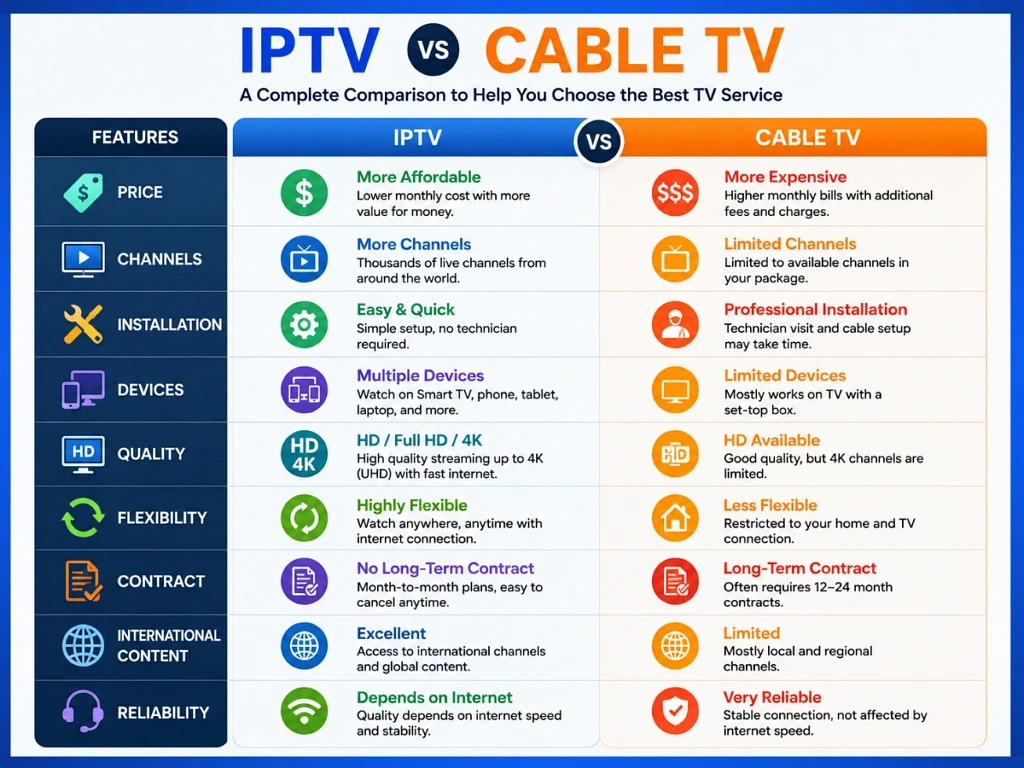
 IPTV and Cable TV Features Comparison Including Cost, Channels and Devices
The Hidden Cable Surcharge Dissection
When you review a typical Comcast Xfinity, Charter Spectrum, or Cox cable television statement, the advertised base package represents only a fraction of the final charge.
The typical American cable bill includes multiple mandatory fees:
- Broadcast TV Surcharge ($25.00 – $38.00 / month): An arbitrary monthly fee invented by cable operators to pass on the costs of retransmitting basic local affiliate networks (ABC, CBS, NBC, Fox)—channels that are broadcast over-the-air completely free with an antenna.
- Regional Sports Network (RSN) Fee ($14.00 – $22.00 / month): A mandatory monthly fee forced onto every subscriber to subsidize regional sports broadcast rights, even if you never watch a single sporting event.
- Hardware Set-Top Box Rental ($12.00 – $18.00 / box / month): Leased equipment fees for the hardware box connected to your living room television. If your home has three televisions, you pay upwards of $45 per month just in equipment rental fees.
- Cloud DVR Storage Fee ($10.00 – $20.00 / month): Surcharges for recording live broadcasts.
- Franchise Fees & State Regulatory Taxes ($8.00 – $15.00 / month): Local municipality utility taxes added to the bottom line.
A cable package advertised at "$79.99/month" routinely results in an actual out-of-pocket monthly expenditure of $160.00 to $230.00 per month.
The IPTV Financial Equation
By contrast, premier IPTV services like Strong 8k tv operate on a model of complete financial transparency:
- Zero Equipment Rental Fees: You utilize streaming hardware you already own (Amazon Fire TV Stick, Apple TV, Nvidia Shield, Smart TVs, smartphones).
- Zero Mandatory Surcharges: No Broadcast TV fees, no RSN fees, and no franchise taxes.
- Inclusive Content Access: Over 50,000 live channels, premium sports networks, and 120,000+ VOD movies are bundled into a single flat rate.
- Subscription Pricing: Premium IPTV typically costs between $12.00 and $18.00 per month, or under $80 to $100 for an entire annual plan.
3-Year Total Cost of Ownership (TCO) Comparison:
┌────────────────────────────────────────────────────────────────────────┐
│                   3-YEAR TOTAL COST OF OWNERSHIP (TCO)                 │
├───────────────────────────────┬───────────────────┬────────────────────┤
│ Expense Category              │ Traditional Cable │ Strong 8k tv IPTV  │
├───────────────────────────────┼───────────────────┼────────────────────┤
│ Base TV Package (36 Months)   │ $3,600 ($100/mo)  │ $240 ($80/year)    │
│ Broadcast TV & RSN Fees       │ $1,620 ($45/mo)   │ $0 (Included)      │
│ 2x Set-Top Box Rentals        │ $1,080 ($30/mo)   │ $0 (Own Hardware)  │
│ Cloud DVR Service             │ $360 ($10/mo)     │ $0 (App Integrated)│
│ Hidden Taxes & Surcharges     │ $432 ($12/mo)     │ $0                 │
├───────────────────────────────┼───────────────────┼────────────────────┤
│ TOTAL 3-YEAR CASH OUTLAY      │ $7,092            │ $240               │
│ TOTAL 3-YEAR SAVINGS          │ —                 │ $6,852 SAVED       │
└───────────────────────────────┴───────────────────┴────────────────────┘
Switching from traditional American cable to a premium IPTV provider saves the average household more than $2,000 every single year—funds that can be redirected into higher home internet tiers, family vacations, or savings.
Category 2: Contract Flexibility vs. 2-Year Lock-In Traps
Traditional cable companies remain notorious for binding customers to rigid, multi-year service agreements designed to penalize viewers who attempt to leave:
The Cable Contract Trap:
- Mandatory 1-Year or 2-Year Commitments: In exchange for introductory pricing, customers are locked into binding legal agreements.
- Severe Early Termination Fees (ETFs): If you relocate, downsize, or cancel service early due to dissatisfaction, cable operators penalize you with ETFs ranging from $10 to $20 per remaining month, often resulting in hundreds of dollars in cancellation penalties.
- The "Promo Expiration Shock": After month 12 of a 24-month contract, your introductory rate quietly expires, causing your monthly bill to jump by $40 to $80 per month without notice.
The IPTV Freedom Standard:
- 100% Contract-Free: Subscriptions operate on a prepaid basis. You can subscribe for 1 month, 3 months, 6 months, or 12 months with zero automated contract extensions.
- Zero Cancellation Penalties: If you travel for the summer or want to pause your service, simply let your plan expire. There are no cancellation fees, no phone calls to retention specialists, and no penalties.
- Predictable Pricing: You pay a flat renewal rate that never inflates without warning.
Review our flexible, non-binding subscription options to find the ideal package for your viewing habits.
Category 3: Channel Selection & International Variety
When evaluating channel variety, traditional cable and IPTV represent two fundamentally different philosophies:
Traditional Cable TV Bundles:
The standard American cable package offers between 120 and 250 channels. However, the majority of these lineups consist of repetitive shopping channels, regional infomercials, secondary music loops, and filler networks you never watch.
Worse, traditional cable packages are severely regionalized. If you move from Chicago to Dallas, you lose access to your Chicago local news broadcasts and regional sports networks. If you are an expatriate or multilingual viewer living in the United States, accessing channels from the UK, France, Germany, Spain, the Middle East, or Latin America requires subscribing to exorbitant "International Add-On Packs" costing $20 to $40 per month for just 3 to 5 channels.
Modern IPTV Lineups:
Because IPTV operates over global internet protocols, geographic broadcasting boundaries disappear completely:
- Over 50,000 Live Global Channels: Access virtually every major broadcast network across the United States, United Kingdom, Canada, Europe, Latin America, the Middle East, Africa, and Asia.
- Comprehensive Regional US Coverage: Stream local ABC, CBS, NBC, and Fox affiliates from major metropolitan markets across the country, allowing you to follow your hometown news and sports regardless of where you live.
- Specialized Niche Programming: Enjoy dedicated 24/7 channels for cinema genres, kids entertainment, documentary networks, and vintage television classics.
Explore our expansive directory of over 50,000 live channels & 120,000+ VOD titles to browse our international offerings.
Category 4: Live Sports Coverage (The Ultimate Battleground)
For millions of American households, live sports are the sole reason they maintain an active television subscription. How do the two platforms compare on game day?
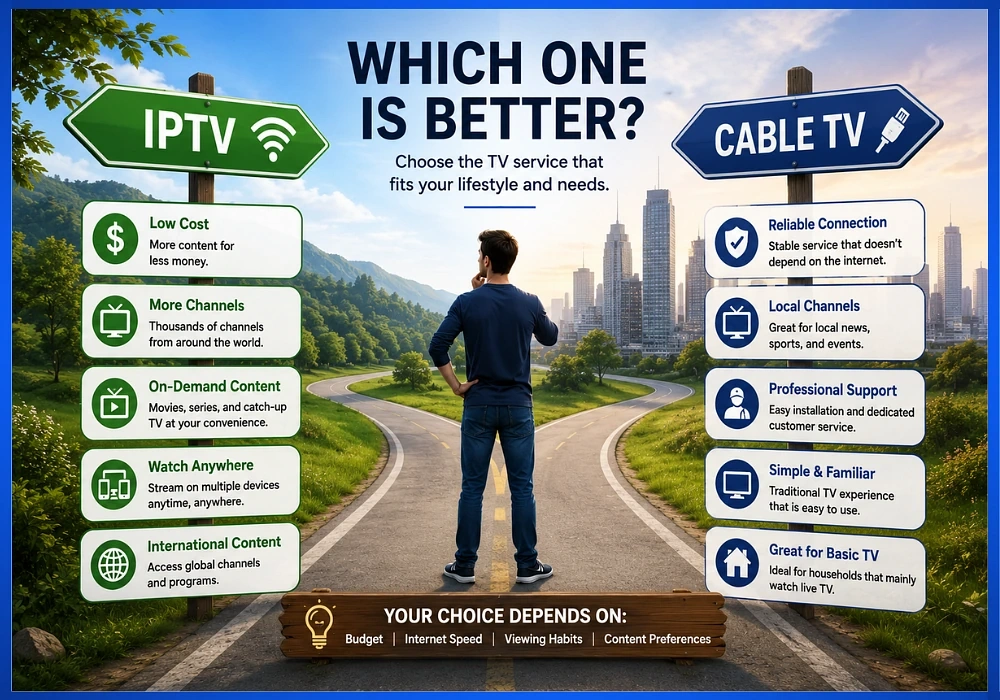 Choosing Between IPTV and Cable TV for Home Entertainment
The Frustration of Cable Sports Blackouts
In recent years, traditional cable sports viewership has become a nightmare of contract disputes, carriage blackouts, and fragmented streaming rights:
- Regional Sports Network (RSN) Blackouts: Cable giants like Comcast and Spectrum have repeatedly dropped major regional sports networks (such as Bally Sports, MASN, or YES Network) due to carriage fee disputes, leaving local fans unable to watch their home baseball, basketball, and hockey teams.
- Fragmented Premium Passes: Following every game on cable requires subscribing to multiple expensive add-on subscriptions: NFL Sunday Ticket on YouTube TV ($350–$450/yr), NBA League Pass ($100–$150/yr), MLB.TV ($150/yr), and expensive Pay-Per-View fees ($80+ per UFC event).
The Comprehensive IPTV Sports Experience
A premier sports-focused service like Strong 8k tv gathers the entire global sporting landscape into a single, unified interface:
- Complete US Sports Coverage: Watch every out-of-market NFL game, NBA League Pass feed, MLB Extra Innings broadcast, and NHL Center Ice match without geographic blackouts.
- Global Combat Sports & PPVs: Access major Saturday night UFC Pay-Per-View cards, championship boxing bouts, WWE, and AEW events included directly within your subscription.
- International Soccer & Motorsport: Stream English Premier League, UEFA Champions League, La Liga, Serie A, Formula 1, and MotoGP feeds in native 50 FPS and 60 FPS.
- Multi-View Capabilities: Using advanced players like TiviMate on Android TV, you can split your screen into 4 simultaneous live feeds, allowing you to watch multiple NFL Sunday games or soccer matches side-by-side.
For an exhaustive guide on sports streaming optimization, read our article on the best IPTV for live sports in the USA.
Category 5: Picture Quality & Resolution (Cable 720p/1080i vs. IPTV 4K & 8K)
One of the best-kept secrets in the American telecommunications industry is that traditional cable television delivers surprisingly mediocre visual resolution.
The Cable Compression Reality:
Despite owning advanced 4K OLED and QLED televisions, most cable subscribers are watching heavily compressed, dated video signals:
- 720p and 1080i Dominance: The vast majority of cable networks—including Fox, ABC, ESPN, and local affiliates—broadcast natively in 720p progressive or 1080i interlaced resolution.
- Severe Coaxial Bandwidth Bottlenecks: Because cable operators must cram hundreds of channels into finite coaxial radio frequencies, they apply aggressive MPEG-2 and MPEG-4 compression to save bandwidth. This creates visible macroblocking, washed-out color gradients, and heavy motion blur during fast-action sports broadcasts.
- Almost Zero Native 4K: Cable operators offer at most one or two temporary "4K Event" channels for major championship broadcasts, requiring special 4K set-top box upgrades.
The Modern IPTV Visual Standard:
IPTV broadcast feeds are delivered across high-capacity internet transit lines utilizing state-of-the-art compression codecs:
- Authentic 1080p at 60 FPS: Experience sports and action in true Full HD running at 60 full frames per second, delivering liquid-smooth motion that puts cable 1080i to shame.
- Dedicated Ultra HD 4K Channels: Enjoy pristine 3840 x 2160 resolution feeds with wide color gamuts and HDR contrast for premier soccer, football, and cinema.
- Next-Gen 8K Feeds: Services like Strong 8k tv deliver bleeding-edge Ultra 8K streaming feeds that maximize the full visual capabilities of massive living room displays.
If you ever experience visual stutter on high-resolution streams, review our technical guide on how to fix IPTV 4K buffering problems.
Category 6: Video on Demand (VOD) Libraries
How do the two platforms compare when you want to watch movies and television series on your own schedule?
Cable On-Demand Limitations:
- Pay-Per-View Rental Extortion: While cable boxes include an "On-Demand" tab, newly released theatrical films typically require renting for $5.99 to $19.99 each, with strict 24-to-48-hour viewing expiration windows.
- Sluggish Navigation: Cable box on-demand interfaces are notoriously slow, clunky, and ad-supported.
- Limited Television Boxsets: Cable networks frequently make only the most recent 3 to 4 episodes of a series available on-demand, forcing viewers to subscribe to separate streaming apps to watch complete seasons.
IPTV On-Demand Superiority:
- Massive Integrated Libraries: Top-tier IPTV services include vast VOD archives containing over 120,000+ movies and complete television series.
- Instant Access to New Releases: Stream the latest blockbuster theatrical releases in pristine 4K Web-DL quality without paying a cent in rental fees.
- Full Trick-Play Controls: Pause, rewind, fast-forward, and resume playback across all your devices with multi-language subtitle support.
Category 7: Device Freedom & Multi-Room Mobility
The physical constraints of traditional cable television severely restrict how and where you can enjoy your entertainment:
The Cable Box Prison:
- Tethered to Coaxial Wall Outlets: Every television in your home must be physically tethered to a coaxial cable outlet and a leased cable box. If you want to put a television on a backyard patio, in a garage workshop, or in a guest bedroom without a coaxial drop, you must pay expensive electrician wiring fees.
- Zero Travel Mobility: You cannot take your physical cable box to a hotel, vacation rental, or business trip. Cable mobile apps (like the Xfinity Stream app) routinely block out-of-home streaming for high-demand sports and premium channels.
The IPTV Multi-Device Freedom:
- 100% Wireless Flexibility: IPTV operates over Wi-Fi and Ethernet. You can place a television anywhere in your home that receives a wireless signal.
- Universal Hardware Compatibility: Stream on the hardware you already love:
- Living Room: Smart TVs (Sony, Samsung, LG, TCL), Nvidia Shield TV Pro, Apple TV 4K, Amazon Fire TV Stick 4K Max.
- Mobile & Travel: iPhones, iPads, Android smartphones, Windows laptops, and MacBooks.
- Watch Anywhere on Earth: Take your entertainment with you. Whether you are traveling for work, vacationing in a rental cabin, or commuting on a train, simply launch your IPTV app and stream your hometown channels instantly.
For simple setup instructions on any screen, explore our step-by-step installation guides.
Category 8: Reliability, Weather Resilience & Internet Dependence
When evaluating broadcast reliability, both platforms demonstrate unique strengths and vulnerabilities:
Traditional Cable Reliability:
- Independent of Home Internet: If your home broadband goes down due to local ISP maintenance, traditional cable television continues playing normally because it travels over isolated coaxial frequencies.
- Satellite Weather Fade: If you use satellite television (DirecTV or Dish Network), severe rainstorms, heavy snowfall, or high winds frequently cause "rain fade," cutting satellite signals completely during severe weather.
IPTV Network Dependence:
- Broadband Requirement: IPTV requires a stable home internet connection. If your internet connection suffers high packet loss or severe latency, streaming performance will degrade.
- The Modern Fiber Advantage: In 2026, modern optical fiber and high-speed broadband networks achieve 99.9% uptime. With a stable 50+ Mbps connection, IPTV streaming is exceptionally stable.
- ISP Throttling Protection: Unlike cable, IPTV traffic can occasionally be targeted for bandwidth throttling by overzealous ISPs during peak evening sports broadcasts. However, connecting through a modern WireGuard VPN completely eliminates ISP throttling.
To evaluate your home connection readiness, review our guide on what internet speed you need for IPTV in 2026.
Comprehensive 12-Point Feature & Cost Comparison Matrix
| Comparison Feature | Traditional American Cable TV | Strong 8k tv IPTV | The Clear Winner |
|---|---|---|---|
| Average Monthly Cost | $140.00 – $230.00 / month | $12.00 – $18.00 / month | IPTV (Saves 90%+) |
| Hidden Surcharges | Broadcast TV & RSN Fees ($40+/mo) | $0 (Zero Hidden Fees) | IPTV |
| Contract Requirements | 12 to 24 Month Binding Contracts | 100% Contract-Free (Month-to-Month) | IPTV |
| Early Termination Fees | $100 to $400 Penalties | $0 (Cancel Anytime) | IPTV |
| Hardware Rental Fees | $12–$18 / box / month per TV | $0 (Use Existing Devices) | IPTV |
| Live Channel Count | 120 – 250 Channels (Regionalized) | 50,000+ Live Global Channels | IPTV |
| Live Sports Packages | Expensive Add-Ons & Blackouts | Complete Global Sports Included | IPTV |
| Sports Frame Rate | 30 FPS / 60 FPS (Interlaced 1080i) | Native 60 FPS (Progressive 1080p/4K) | IPTV |
| 4K & 8K Resolution | Extremely Rare / 1–2 Event Feeds | Dedicated 4K & Ultra 8K Feeds | IPTV |
| On-Demand VOD Library | Paid PPV Rentals ($5.99–$19.99) | 120,000+ Free VOD Movies & Series | IPTV |
| Device Portability | Tethered to Home Coaxial Wall Drops | Stream on Smart TVs, Phones, Tablets | IPTV |
| Internet Dependency | Independent of Home Broadband | Requires 35–50+ Mbps Internet | Cable (Slight Edge) |
Who Should Keep Cable vs. Who Should Switch to IPTV
To make an objective, honest purchasing decision, consider which profile matches your lifestyle:
You Should Keep Traditional Cable TV If:
- You live in a remote rural area with extremely poor, unreliable internet speeds under 15 Mbps.
- You are uncomfortable using modern streaming remote controls and prefer a legacy numerical cable box keypad.
- You do not care about saving $2,000+ per year and prioritize single-button convenience over channel variety.
You Should Switch to IPTV If:
- You are sick and tired of paying $150 to $250+ per month for a bloated, restrictive cable bill.
- You have a stable home broadband internet connection (50+ Mbps).
- You want unthrottled access to global live sports, Pay-Per-View fights, and out-of-market games without regional blackouts.
- You own modern Smart TVs, Firesticks, or Apple TVs and want to eliminate clutter, wires, and cable boxes.
- You want an expansive, on-demand cinema library containing 120,000+ titles updated daily.
Why Strong 8k tv Is the Ultimate Cable Replacement in 2026
If you are ready to make the break from traditional cable, Strong 8k tv is engineered specifically to deliver a seamless, high-performance transition:
- Enterprise Anti-Freeze 10.0 Technology: Redundant server clusters hosted across North America and Europe balance traffic dynamically, eliminating the buffering loops that plague low-tier providers.
- Over 50,000 Live Channels: Complete coverage of US major networks, regional sports, Canadian packages, UK entertainment, and international networks.
- Ultra 8K & 4K 60FPS Streaming: True high-bitrate video streams that bring live sports and cinema to life on your 4K and 8K screens.
- Dedicated 24/7 Human Support: Instant setup guidance, personalized troubleshooting, and tokenized test access available via WhatsApp.
Before committing, you can test our service firsthand by following our guide on how to test an IPTV service before buying a subscription.
Frequently Asked Questions
Final Verdict: The Inevitable Triumph of IPTV
Traditional cable television in the United States is a legacy 20th-century technology attempting to survive in a 21st-century digital world. With bloated channel bundles, punitive contracts, hidden equipment rental fees, and dated 720p picture quality, cable no longer represents a viable value proposition for the modern consumer.
Modern IPTV delivers everything television should be: freedom of choice, thousands of global live channels, stadium-grade 60 FPS sports, massive 4K on-demand libraries, and universal device portability—all at a 90% cost reduction.
The verdict for 2026 is clear: IPTV is the undisputed future of television entertainment.
Take control of your home entertainment today. Explore our subscription packages, review our complete channel lineups, or reach out to our team on WhatsApp for instant test access to join the cord-cutting revolution now.